
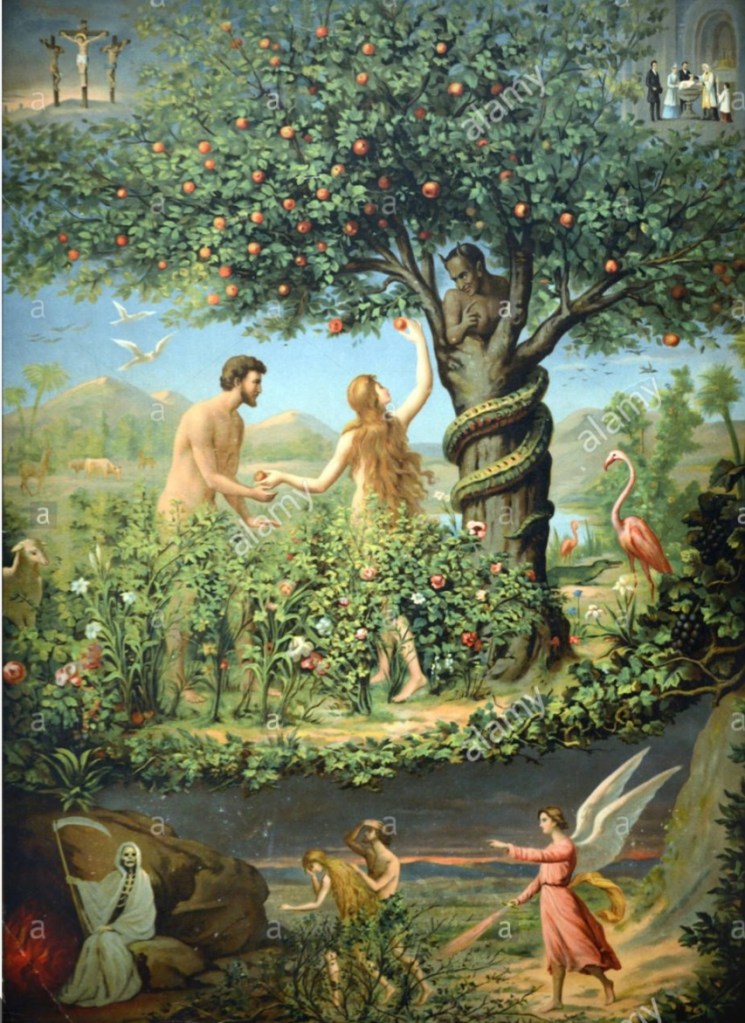
1. The fall refers to the rebellion of God’s image-bearers in the garden of Eden.
Genesis 3 is a threshold in the Bible’s storyline. While dwelling in a sacred space and surrounded by the blessings of God, Adam and Eve did what God had forbidden. God had made them in his image, but they defied his word and sought a kind of knowledge in an unsanctioned way. Made for communion with God, they experienced alienation. Made for trust and hope and life abundant, they descended into sin and shame. They fell.
2. The fall is a nonnegotiable piece of the Creation-Fall-Redemption-Consummation paradigm.
One of the most popular schemas for the Bible’s “big story” is the fourfold chain of words: creation, fall, redemption, consummation. Creation tells us what God made, the fall tells us what happened to it, redemption tells us what God has done to address what happened, and consummation tells us where everything is headed. If the notion of the fall were removed, the implications would be disastrous. Let’s engage in a thought experiment. If there is creation but no fall, then what explains all that has gone wrong in the world? If there is redemption but no fall, why would redemption be necessary? If there is consummation but no fall, why would the Christian’s hope be oriented toward a new heavens and new earth and resurrection life?
3. The serpent in Genesis 3 was Satan, the archnemesis of God and God’s people.
The tempter in Genesis 3 does not have the best interests of Adam and Eve in mind. The serpent counters and twists God’s words. But throughout the account, the tempter is never called by name. If interpreters suspect that this is Satan himself tempting Eve, they would be correct, because he is certainly the archenemy of God’s people and the purposes of God. The New Testament confirms this identification. God told the serpent that it would be crushed (Gen. 3:15), and Paul told the Romans that “The God of peace will soon crush Satan under your feet” (Rom. 16:20). John says in Revelation, “The great dragon was thrown down, that ancient serpent, who is called the devil and Satan, the deceiver of the whole world” (Rev. 12:9).
4. The fall is treated as a historical event by later Scripture.
Because the Holy Spirit has inspired the writings of Genesis through Revelation, and because God does not err, we can trust the biblical accounts in what they reveal about God and God’s dealings with the world he’s made. Later Scripture does not contradict earlier Scripture, but we continually see how earlier Scripture is clarified and confirmed by the progressive revelation across the writings of the biblical authors. In Romans 5:12–21, the obedience of Christ contrasts the disobedience of Adam. In 1 Corinthians 15:21, Paul says that “by a man came death.” And in 2 Corinthians 11:3 and 1 Timothy 2:14, he mentions the deception of Eve. The New Testament treats the Old Testament account of the fall as a historical rebellion of a real Adam and a real Eve.
(Gen. 3:14–19). These pronouncements included a promise: the serpent would be defeated by a future son from Eve. This good news meant that the vile creature who had twisted God’s words and tempted God’s people would be subdued himself. God told the serpent, “He shall bruise your head, and you shall bruise his heel” (Gen. 3:15). This promise is the seedbed of messianic prophecy. Jesus would be the seed of the woman crushing the serpent. But this victory would come at a cost. The serpent would strike the heel of the promised son, which implies the son’s suffering. When we look at Genesis 3:15 in the fullness of canonical revelation, we can rightly see that messianic hope begins with a promise of victory through suffering.
9. Adam named Eve as an act of faith.
Adam and Eve did not experience an immediate physical death in Genesis 3. They were exiled from Eden (Gen. 3:22–24). But before leaving the garden, “The man called his wife’s name Eve, because she was the mother of all living.” This naming was an act of faith. Adam and Eve had received pronouncements of judgment in Genesis 3:16–19, yet they heard about a future son who would come from Eve (Gen. 3:15). Because the woman would be the mother of the living—her descendants—she was named “Eve,” which sounds like the Hebrew word for “living.” Her name showed faith in God’s promise. God promised future offspring, and Adam believed him.
10. The failure in the garden anticipated faithfulness in a garden.
The garden of Eden isn’t the only garden in Scripture where testing took place. In the New Testament Gospels, the Lord Jesus is in the garden of Gethsemane when he is arrested and taken to a series of Jewish and Roman trials. He was moving ever closer toward the cross, and in Gethsemane, he had resolved to do the will of God—which would mean taking the cup of divine judgment in our stead (Matt. 26:36–42). Gethsemane was not a garden of failure for Christ. He was not like the first Adam who failed to trust the Lord and who defied God’s will. The Son of God, the seed of the woman, faced the agonies of Gethsemane with resolve and perseverance. He did not turn. For the joy set before him, he endured the cross (Heb. 12:2). In the first garden, the first Adam had failed. In a future garden, the last Adam was faithful.




 ENDTIME PRAYER RADIO AND TRIPLE K. MEDIA, BELONGS TO BISHOP DR. PETER ABABIO AND REV. SABINA NSIAH ABABIO..
Leave a comment