
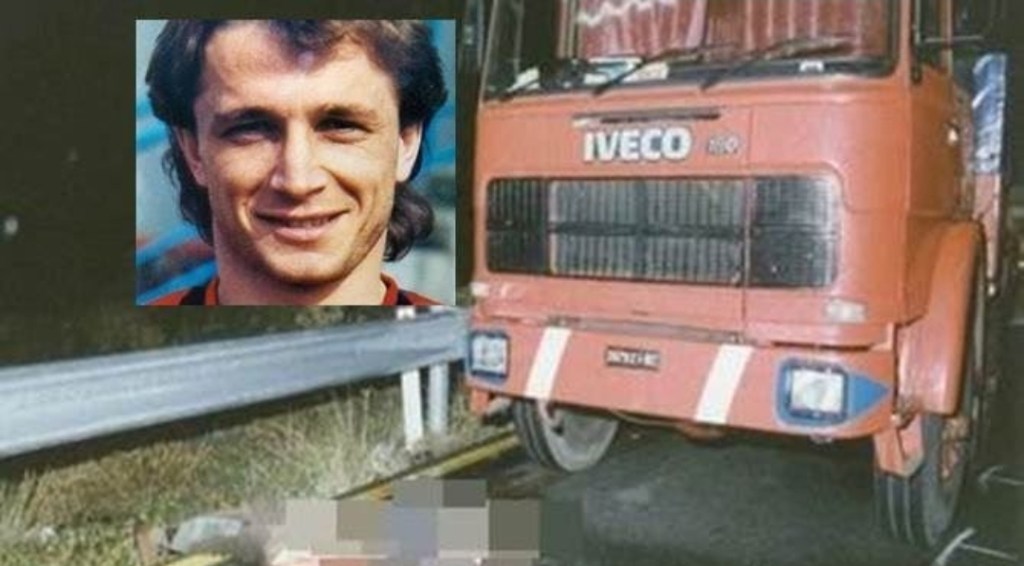
A few days after the tragedy he wrote an anonymous letter to deny Isabella Internò about the suicide of the Cosenza footballer. What he describes, however, is not a crime scene. This is why her story could be authentic
The voyeurs of the SS 106 Ionian. Crouched in the shade, in Roseto Capo Spulico, on an autumn afternoon many years ago. They thought they were spying on a couple in love and, instead, they witness a scene of death and desperation. On November 18, 1989, Donato Bergamini and his girlfriend Isabella Internò may not have been alone on that dirt pitch. It is likely that there were also two such characters with them. From the investigation documents, buried under thousands of other documents, emerges a letter written about ten days after the tragedy by a man who, without revealing his name, presents himself as an eyewitness to the last moments of the Cosenza footballer’s life. He claims to have found himself there “in the company of a friend”. And the scene he describes is very different from that of a murder.
Report of an accident
In the writing, which remained unpublished for 34 years, it tells of a heated discussion between the two young people, with Bergamini accusing Internò of betrayal. At a certain point, poor Denis gets out of the car cursing the girl – who in the meantime is crying profusely – and meets his fate. A few more seconds, in fact, and Pisano’s truck arrives and hits him. However, it would have been a fatality that the author of the letter attributes to a moment of “distraction” on the part of the driver, therefore not to the will of the footballer. «Donato didn’t want to die» specifies the anonymous person. And it is no coincidence that what he tells seems like the chronicle of an accident. Voyeurs, then. Often harmless profile, sometimes lethal. Quite widespread at the time and today almost completely extinct. That evening, were two of them really hidden in the fateful pitch? Numerous elements point towards the authenticity of the writing. There is no shortage of error, however macroscopic, because it is destined that in this matter nothing should ever fit together perfectly. We will talk about it, but let’s start first from the opposite signs.
Impossible coincidences
To begin with, this is not a document in favor of Isabella Internò, currently on trial for voluntary manslaughter. Far from it, as demonstrated by the final consideration of a moralistic nature. Furthermore, the story contradicts her precisely on the fulcrum of the defense thesis: suicide. Dismissing it as an attempt at misdirection, therefore, would be completely illogical. The text describes Bergamini’s conduct in those fatal moments – “he started walking on the side of the road” – and this cannot be a detail extrapolated from the statements of Pisano or Internò. Neither of them ever reports this circumstance. Rocco Napoli and his wife Antonietta Valerio will talk about it later, imitated many years later by Berardino Rinaldi, but nine days after the events, no one else could have known that, before being hit, Denis was moving dangerously on the asphalt of the 106. If not for seeing it with your own eyes.
Denis’s secret torments
Even the athlete’s sentimental torments – the topic of the conversation described in the letter – were known at most to some teammates such as Padovano, Lombardo and Nocera, to the coach Simoni and to his father Domizio, but completely unknown to public opinion. No mention of it in the newspapers or on television and from 2012 onwards, the topic will become a taboo. This, however, is another story. What matters is that when he puts pen to paper, the alleged voyeur cannot be privy to such intimate details about their relationship. If not for having learned them with your own ears.
And his last words
“No, I don’t forgive you anymore” the footballer would have said to Isabella, but what did the girl have to make up for? Is it likely that Denis expressed himself in those terms that evening? So had he already forgiven her other times in the past? A possible response still comes from the locker room. According to Michele Padovano, in fact, her partner complained about the alleged relationship that Isabella had had with another footballer, Gabriele Baldassarri, although it dated back to before her arrival in Cosenza, when she was just fifteen. Even all this, the voyeur could not know. «When he talked about it (about Baldassarri, ed.) he turned red, almost purple» Padovano will say on the point.
He had warned her…
The theme of forgiveness then returns in a correspondence between Bergamini and Internò made public by Denis’s family only in 2017. There is a letter that the footballer receives in August 1987 in which Isabella mentions a mistake committed precisely at age of fifteen and guarantees her boyfriend that “stuff like that will never happen again”. In the documents there is also one written by Denis which seems to be a response to that of the girl. Perhaps it is a rough copy of an original that was then sent. Or after drafting it, the player gave up on posting it. The fact is that at that moment, she warns her girlfriend that she will not tolerate any other behavior that he does not like. “This time I won’t forgive”, is her warning engraved at the bottom of the text. It goes without saying that, in November 1989, no one, apart from those directly involved, could have been aware of the content of this correspondence.
The “right” mistake
This brings us to inaccuracies. The one about the truck mistaken for a “trailer” is a venial one given that, immediately, Raffaele Pisano’s Fiat Iveco is defined as such in almost all journalistic reports, both in newspapers and on TV. More serious, however, is the description of the vehicle hitting Bergamini with “the rear end”, whereas the exact opposite is certain. Is one word out of place enough to make the writer unreliable? To confine him to the already crowded enclosure of the mythomaniacs who have been polluting this story for years? The typo option – he meant one thing and said another – could be valid, but there is a third possibility to take into consideration: that of an error of evaluation.
The darkness beyond the pitch
In fact, not even Isabella and Pisano have ever been able to explain with precision what really happened in those two or three fatal seconds. And twenty years later, their hesitations created the conditions for the conspiracy theory to take off. If, however, things had gone as the voyeur describes them, there is no doubt that Bergamini’s death would have represented an unexpected and above all shocking event for both of them. Moreover, it occurred in the worst conditions possible for them, both environmental and emotional. Moreover, the state of those places was described effectively by Andrea Toschi, lawyer of the Bergamini family at the time. «You can’t see where you are, where you are putting your feet» he himself notes following an inspection carried out on the pitch and the surrounding area. In short, that evening the shock of the moment and the surrounding darkness could have partially misled all the witnesses, including the most indiscreet of the company. That his eyesight betrayed him, however, is one thing. Whether hearing did it too is another matter entirely.
A moment of distraction
When the author reports what he claims to have heard, he does so with quotation marks, which is more unique than rare for an anonymous letter. Doubts, if anything, emerge when the tone becomes assertive. Logically, it is almost impossible that from his position, out of the way and in the dark, he could have even caught the truck driver’s moment of distraction. Yet, the latter, on 6 December 1989, told Abbate something that sounded like a half-admission. He tells him that he noticed that the Maserati had Ferrara license plates, a circumstance that surprised him since in that “terraccio” clearing he was used to only seeing cars with the license plates of Cosenza and Bari. It is possible that while he was thinking about the names of the cities, even if only for a moment, took your eyes off the road?
Out of the shadows
Even assuming that behind this story there is also a small but fatal drop in attention when driving, it is still not clear how the voyeur managed to notice it. Unless it was the truck driver himself who confided it to him. As is known, after the accident, the lorry driver reversed briefly because someone told him they heard Bergamini asking for “help” from under the truck. Who’s telling him? This person has never been identified, is it possible that he was our voyeur? And that he and Pisano spoke immediately after the tragedy? And again: the first to receive the report of an accident near the Roseto castle were the Carabinieri of Montegiordano. Nothing strange since, for any emergency calls, the number of that station was indicated on the vertical signs of the Ss 106. Was he still the one who made the phone call after leaving the scene of the accident?
Psychology of a voyeur
Unlike real mythomaniacs, ours does not throw accusations, does not cast shadows or suspicions. There is no evidence of any defamatory or self-congratulatory intent on his part. In the same file, needless to say, there is another letter full of conjectures on drugs, football betting and organized crime which bears the signature of “A citizen who wants justice”. In the sad story of Lisa Gabriele – just to stay on the subject of Cosenza cold cases – the input for the reopening of the investigations is offered by the report, always anonymous, of an “honest policeman” in a world of corrupt people, etc. etc. This proves how fans of the genre often tend to ennoble themselves. In this case, however, the writer does not deny having had deplorable purposes – “We immediately thought it was a couple” – but he takes it a little at a distance, without explicitly defining himself for what she is. As if mythomania isn’t guiding his hand. If anything, a certain modesty.
A possible identikit
The letter is addressed to Santi Trimboli, a journalist who followed the case with great attention in those days, both on behalf of Rai and Corriere dello Sport. The reporter received it on November 29th and delivered it to Abbate on the same day. It is almost certain that it was written in a place not too far from the scene of the events. This is demonstrated by a correction made on the envelope. The mistake made in reporting the postal code of the city of Cosenza, the location to which the letter is intended, is clearly visible. The zero inserted in place of the one refers to the postal codes assigned to the centers of the Ionian coast. Evidently they are the ones that the sender is used to handling most often. And so it is possible that for a moment, habit made him confused. Who is this mysterious man?
Between the railway and the West
It could have been one of the workers then engaged in work on the railway network below. It is very likely that some of them were also at work on that Saturday in November. It’s a track. The other takes us between the tracks and the square, where there are buildings owned by Anas which are now in a state of abandonment. Were the two friends stationed there when they saw Denis and Isabella arrive? And there is also a third hypothesis: a few meters away stands the “Baia bella” tourist village, a series of terraced houses at the time supervised by a caretaker. Some inhabited only in the summer, others were incomplete and remain so today. Does the residence have anything to do with it? What is certain is that as dark as that lay-by was, it is difficult to imagine that it also accommodated another vehicle at that moment. Some motorists passing by immediately before notice only the white Maserati. The explanation, therefore, could be found there: between the railway and the West.
Because no one has ever looked for it
It is not surprising that until today no one has ever given weight to this letter. Anonymous writings cannot be used in judicial investigations, but they can still guide investigators, suggesting which leads to follow and which to discard. In 1990, at the time of the first investigation into Bergamini’s death, no one went so far as to imagine that the footballer had been killed. The truth, in those years, remains poised between suicide and manslaughter, a charge for which Pisano will be called to answer in court. Twenty years later, when the case reopens under the media pressure of the internet and TV broadcasts, the new investigators revisit the story and after 24 months of investigations, come to the conclusion that there is no murderer. For them, the letter from the couple’s spy – assuming they took it into consideration – may have represented at most a confirmation of much other evidence contrary to the murder theory. This is to say why, until today, no one has ever looked for that voyeur. Thirty-four years later, however, the situation changes radically
The pending truths
The latest investigators to tackle the case think that Bergamini was killed. And they believe they have ascertained this with new forensic medicine techniques tested on his remains exhumed in 2017. However, if what the invisible witness says is true, then they are wrong. The truth would be that already hypothesized by the Castrovillari Prosecutor’s Office in 1989: a road accident with responsibilities that are however uncertain and no longer assessable. And even more importantly, Isabella Internò is not a murderer at all. Her only fault, if anything, would consist in not having told the truth about the actual tenor of her last conversation with Denis.
Small provincial secrets
«Her main concern is not to be held up as morally responsible for the suicide» wrote the magistrate Mario Mirabile in 1991, referring to Isabella. And 34 years later, now that she is 53, the woman could still be a prisoner of that lie told when she was only 19, out of common sense of decency. Behind the Bergamini case, therefore, there could only be a provincial secret, small and unspeakable. In this story everyone has one to cherish, including the voyeur of the SS 106. A ghost, yet another, that hovers over the sad story of Donato Bergamini. And unlike other ghosts, however, he seems to know too many things. For not being true.

 ENDTIME PRAYER RADIO AND TRIPLE K. MEDIA, BELONGS TO BISHOP DR. PETER ABABIO AND REV. SABINA NSIAH ABABIO..
Leave a comment