

Who Were the Ashanti People?
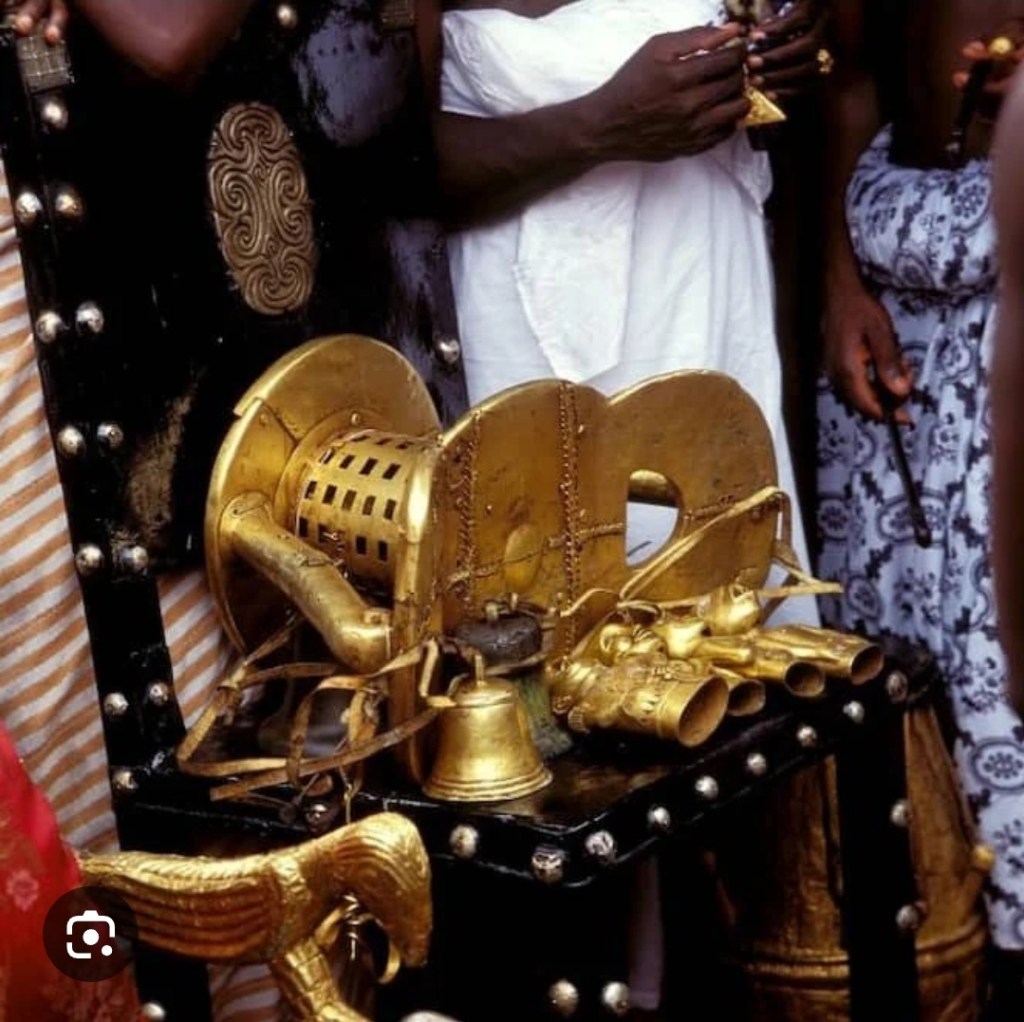
The Ashanti are people who live in Ghana and parts of Togo and the Ivory Coast. Once the rulers of a significant empire, the Ashanti have preserved many of their historic traditions.
The Ashanti Tribe’s History
The Ashanti people are closely intertwined with the history of Ghana. From the seventeenth to the nineteenth centuries, much of the territory of the present-day country of Ghana belonged to the Ashanti Empire. Kumasi, the capital of the Ashanti state, governed hundreds of villages. The Ashanti Empire is often classified as one of Africa’s slave kingdoms, as they traded slaves and gold with both African and European powers.
The Origins of the Ashanti Ethnic Group
It is believed that the Ashanti ethnic group settled in the rainforests of what is today Ghana between the eleventh and thirteenth centuries. The original form of political and social organization was the Ashanti tribe. However, there were ties to other groups from the beginning.
The Ashanti are part of a larger group, the Akan, and share many cultural characteristics with other Akan peoples. Their staple crops are yams, and they also eat plenty of plantains and taro. Ashanti ethnicity is claimed by millions of modern Ghanaians today. While many Ashanti have moved to cities, the majority of their modern population is rural, and ancient lifeways are still preserved in contemporary villages.
The Rise of the Ashanti Kingdom
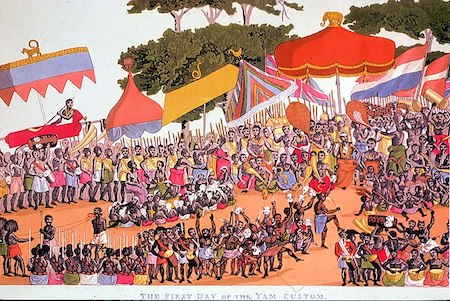
As the Ashanti tribes grew in size and power, they began forming kingdoms. In 1670, Osel Tutu united all the kingdoms and became Asantehene, or king, of the Ashanti Empire in 1696. Tutu is regarded as an expert diplomat, and he immediately negotiated several alliances to create the Ashanti Union in 1700. He also built a capital, Kumasi, which remains an important city in modern Ghana.
Within fifty years, the Ashanti commanded the largest and strongest state on the Guinea Coast. They had two great sources of wealth. First, they controlled access to highly productive gold mines. The region was so rich in gold that Europeans simply called it the ”Gold Coast.” Second, they ran an exceptionally profitable slave trade. Thanks to their wealth, many Ashanti were able to specialize in crafts, and their woodcarvings and textiles are renowned for their beauty.
The legitimacy of the Asantehene came from the Golden Stool. Ashanti people believe that the Golden Stool came down from heaven, and it serves as the Asantehene’s throne. This shows that the king is favored by the gods.
The Ashanti Tribe and Slavery
The Ashanti Kingdom built an extensive network of slave catchers and traders to become a major source of Sub-Saharan slaves for both African and European customers. Originally, the Ashanti traded slaves to the north with the Hausa and Mande people. However, towards the end of the eighteenth century, the trade shifted south to the coast, in accordance with the entry of British, Dutch, and French clients. Many slaves sold by the Ashanti ended up in the Caribbean, and some aspects of Jamaican culture reflect Ashanti traditions.
The Ashanti People During the Colonial Period
The British outlawed the slave trade in 1807 and began a costly and prolonged worldwide campaign to wipe it out. Surprisingly, they were even willing to go to war with foreign powers in order to end the slave trade. This put them at odds with the Ashanti, who relied on slavery for much of their wealth. In addition, the Ashanti practiced human sacrifice, a practice the British viewed as barbarous. Making matters worse, the Ashanti took control of a territory surrounding the British at Cape Coast. Tensions rose and the first war with Britain started in the 1820s. Though the Ashanti were able to fend off the British, they signed a peace treaty in 1831 to avoid further conflict.
Thirty years later, in 1869, the British took control of Elmina, a city the Ashanti claimed belonged to them. Five years later, a British expeditionary force took Kumasi, occupying it for one day. Though the British success was short-lived, the Ashanti could see that their European rivals had far better military technology, and several northern provinces left the kingdom. From then on, Ashanti power declined precipitously, and Ashanti became a British crown colony in 1902.
Interestingly, the Ashanti king is still an important figure today. Though he must coexist within Ghana’s democratic government, his position is part of the state’s constitution. He is a cultural leader, presiding at traditional ceremonies and even resolving disputes in the traditional Ashanti judicial system, which is used as an alternative to the official court system by many.
The Ashanti Tribe in Ghana and Elsewhere
The Ashanti people are an important part of modern Ghana. Kumasi, the capital of the Ashanti region, is Ghana’s second-largest city and is regarded as the cultural center of the state. The Ashanti language, Twi, is spoken by about nine million people as a first language.
A significant Ashanti diaspora caused by the Atlantic Slave Trade means that many Caribbean people are descendants of the Ashanti. In Jamaica specifically, dialects, symbols, and names bear a significant Ashanti influence. Recent genetic tests indicate that 60% of Jamaicans have Ashanti matrilineal DNA.
The Culture of the Ashanti People
The Ashanti have a unique and vibrant culture that is evident in numerous cultural festivals and religious rituals. Ashanti society is matrilineal, which means that family membership is determined by female ancestors. While the head of the lineage is always a man, both women and men choose the head of the lineage.
The Language of the Ashanti People
The Ashanti’s Twi language belongs to the broader Akan language group. Other languages in this group include:
- Akyem
- Anyi
- Baule
- Fante
- Guang
The Religion of the Ashanti People
The traditional Ashanti religion includes one supreme being as well as many gods of varying power and importance. Moreover, ancestors play an important role in the Ashanti cosmology, and their spirits are thought to be present at all times. The traditional religion includes a host of ceremonies and rituals for major life events such as puberty, marriage, and death.
As more Ashanti move to cities, they come into contact with the world religions of Christianity and Islam. These are now minority religions among the Ashanti people.
The Material Culture of the Ashanti People
Ashanti are known for their production of colorful cloth, which is woven from both cotton and silk. Men are the only weavers, and their patterns may represent everything from social status to celebration. Woodcarving is another important craft, as is the production of talking drums. These drums earn their name because they are used to communicate over long distances.
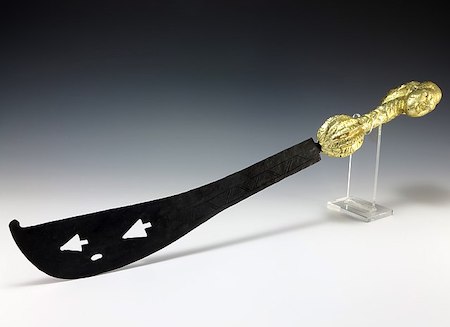
Ashanti architecture traditionally consisted of clay homes with timber frames and thatch roofs. Larger homes would have four rooms surrounding a courtyard. Today, these traditional homes are rare.
Lesson Summary
The Ashanti are an important people in the modern-day state of Ghana. During the seventeenth century, they were united under an Asantehene, or king, in a powerful empire. The Asantehene is said to get his power from the Golden Stool, which is the most important symbol of their culture. Profiting from both gold mines and the slave trade, the Ashanti Empire was a force to be reckoned with until the end of the 1800s. Europeans learned of their wealth and called the entire region the Gold Coast.
Today, the capital of the Ashanti region of Ghana is still Kumasi. Many Ashanti have preserved their tribal customs, including the practice of matrilineal descent. Talking drums are also still produced and feature in some ceremonies.
Frequently Asked Questions
What is the Ashanti tribe known for?
The Ashanti tribe is known for its rich culture, which includes vibrant textiles and beautiful woodcarving. The Ashanti also still have a king and revere him.
What religion is the Ashanti tribe?
The Ashanti have preserved their traditional religion, which includes a supreme being, many gods, and ancestor spirits. Some Ashanti have converted to Christianity or Islam.
Why did the Ashanti trade slaves?
The slave trade was exceptionally profitable for the Ashanti, who were successful warriors. It is worth noting that the slave trade was common throughout the region until it was ended by the British.
Where did the Ashanti tribe originate from?
The Ashanti settled in the modern-day territory of Ghana in the eleventh century. They are considered native to the Ashanti Region.




 ENDTIME PRAYER RADIO AND TRIPLE K. MEDIA, BELONGS TO BISHOP DR. PETER ABABIO AND REV. SABINA NSIAH ABABIO..
Leave a comment