
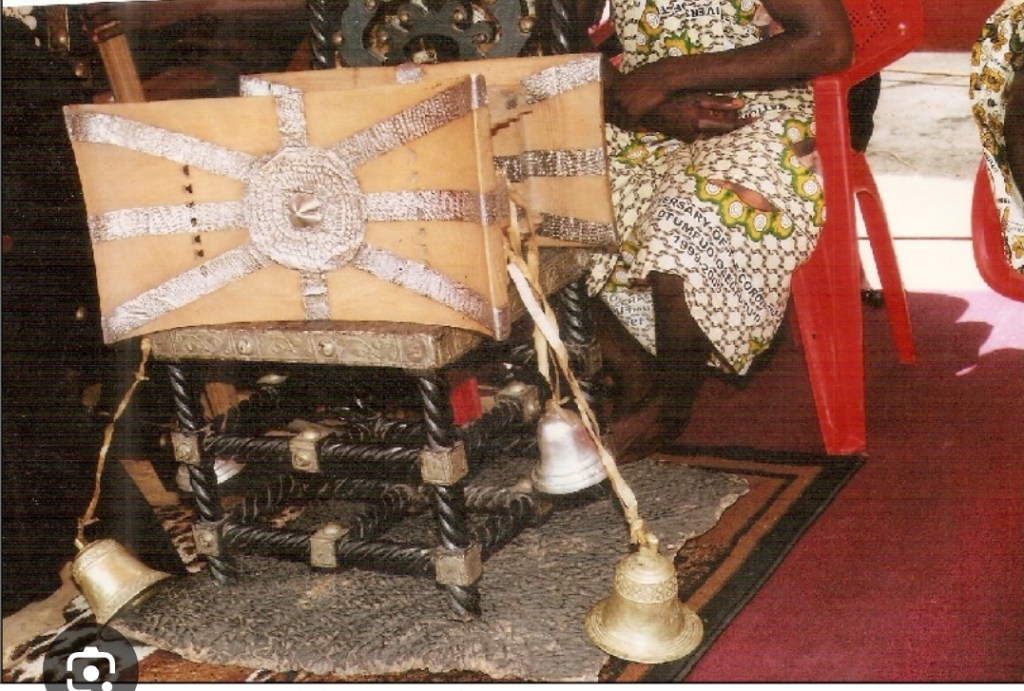
The Silver-Stool is always placed on its side to prevent the spirit of the tree or any wandering spirit to occupy it. It is always carried at the back by the carrier. The three bells attached to the Silver-Stool have to be rung when appearing in the public to announce the arrival of the soul of the state.
The three bells according to tradition represent the three royal houses in the Mampong traditional area. The gathering must always stand-up to show respect to the Silver-Stool when it appears in public. When it appears in public, it is placed on Asipim stool on the immediateleft side of Mampong-hene.
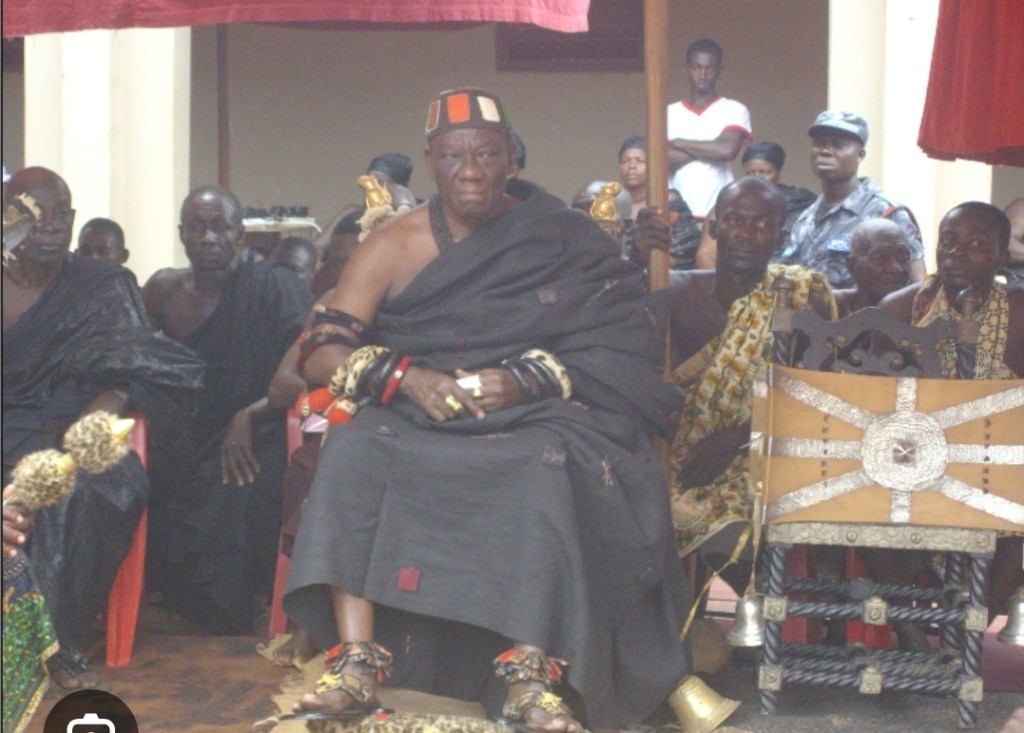
The Silver-Stool must never come into contact with the ground and no one is allowed to sit on it. It is kept with the strictest security and precaution.
It comes out only on exceptionally grand occasions especially installation of a new chief or celebration of a festival. The Silver-Stool is a white wooden stool and it is composed of three parts; the base, the middle and the top.
The base has been shaped in a rectangular form with the width of about one-third the length. The base of the stool signifies the stability of the earth. The rectangular shape on the Silver-Stool signifies the influence of God and males in the Mampong state. This means that, the Mampong-hene being the first born of the state recognizes the importance of God, chiefs and elders in the administration of the state.
The middle portion has five pillars supporting the top with four of the pillars at the corners and one in the centre. The four rectangular-shaped pillars at the corners of the Silver-Stool represent the influence of the male power in Mampong. They signify the strength, power and good fortunes of the state of Mampong and how the state depends on its male citizens for subsistence, growth and protection.
The centre pillar is about three times the size of one corner pillar with circular holes in it. The strong central Pillar represents the power and presence of God whilst the round holes in the centre pillar and the triangular projections signify justice and fairness for which God stands in the Mampong state. Moreover, it represents the eye of the Mampong-hene (Ohene Aniwa) and this is a symbol of vigilance and wariness.
Six triangular designs have been craftily and uniquely carved into the four corner pillars projecting on the length-side of the Silver-Stool. The triangular projections on the four pillars represent male children in Mampong state. The ways in which the projections are attached to the pillars signify how children usually cling to their parents. Children in Mampong state are held in high esteem and considered as the future generations who will grow to sustain and promote the rich and cherished traditions and customs.
The triangles on the Silver-Stool symbolize the influence of females in the state. This is to remind the Mampong-hene of the role women play in the state. The top of the Silver-Stool almost exceed the base in length however, equal to it in breadth. The top has been curved-in to ensure safety and comfort when sitting on it. The top of the Silver-Stool (crescent) symbolizes the loving embrace of a mother. It also represents the warmth and comfort of the female in the Mampong state.
Eight triangular holes have been created at near ends in a straight line at the breadth of the top of the Silver-Stool. The Stool is largely covered with bands of silver.
The silver metal represents second in command or next to an authority. The Silver-Stool of Mampong is next to the Golden Stool



 ENDTIME PRAYER RADIO AND TRIPLE K. MEDIA, BELONGS TO BISHOP DR. PETER ABABIO AND REV. SABINA NSIAH ABABIO..
Leave a comment